
About the author
Jessica Díaz
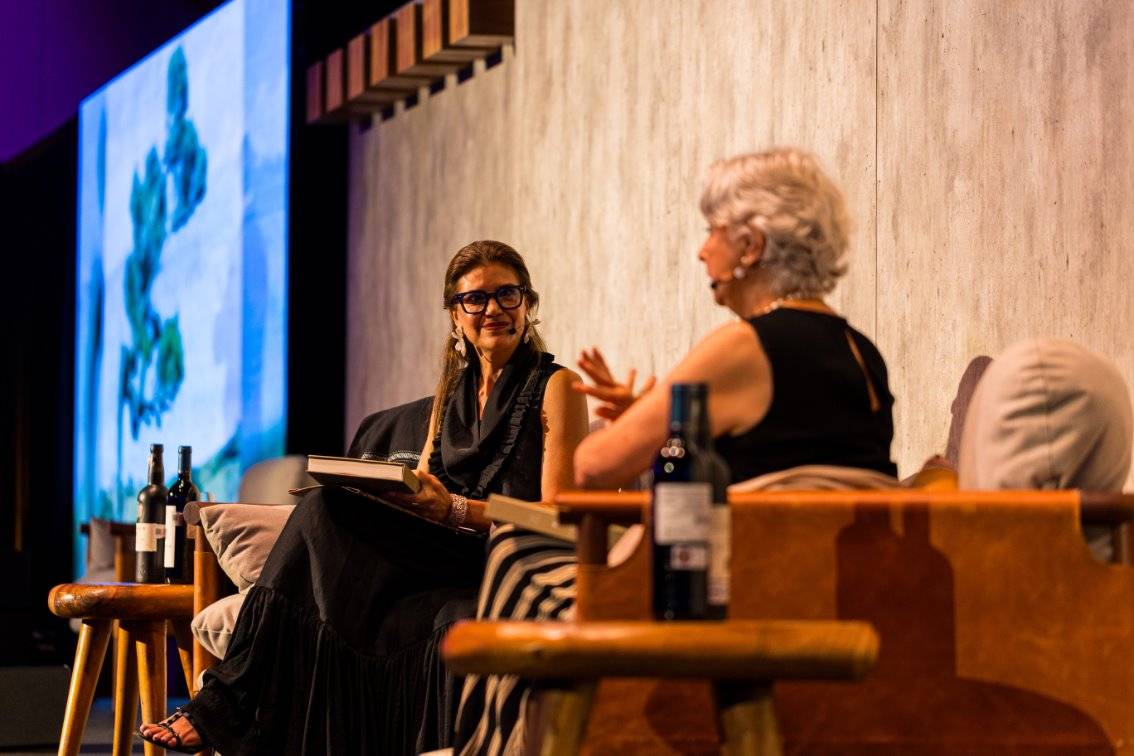
A wine can tell stories of land, time, and transformation. In this conversation with Sandra Fernández, renowned sommelier and an essential part of Apapaxoa, we discover how the barrel adds character, how fire leaves its mark, and how wine becomes a way to remember, feel, and share.
Stories born from the land. Speaking about the origin of wine, how do you think a story is told through wine? What role do origin, grape, and soil play?
Every wine tells a story from the moment it is born in a place with a climate unlike anywhere else in the world, a particular soil composition, and a unique number of days of sunshine.
All of this is reflected in a grape that will be transformed into wine by a winemaker with a particular character and style, someone who interprets what nature gives through the grape and transforms it into wine.
If the person presenting it is a professional, the story has to begin with the soil, climate, and winemaking style, with the history and particular character of the winery… telling the story of the name, the family, the winery, and the wine itself.
Just as a recipe can be inheritance and resistance, what can a glass of wine tell us about a place, a culture, or a person? A great deal. That is why appellations of origin exist. In wine regions, appellations of origin protect the history of a very specific place, a culture and a tradition: the grape variety born in that place.
The art of creating harmony. Beyond flavor, what does pairing mean?
It is harmony: the extension of a bite and a sip in your mouth through an experience multiplied by two elements. It is the continuation of a dish and its story, and a wine and its story, so that everything makes sense in your mouth and becomes richer together than either element would be on its own.
Sometimes you have to create contrasting pairings, which are harder to achieve. Here is an example: if I want to soften the saltiness and metallic character of blue cheese, I need to give you a sweet wine, such as port. That combination is incredible, magical, and textbook-perfect.
I am contrasting it with something that has nothing to do with dairy, salt, or the metallic quality associated with the penicillium in blue cheese. It is a sweet, fortified wine with higher alcohol, noticeably sweet and fruity.
But if I want to respect and not change the flavor of that blue cheese, then I will emphasize it and push it even further forward with a wine that has none of those sweet elements.
It also depends on when you serve it. If I serve it after the meal, I would rather give you a port; if I serve it at the beginning, I do not want to give you anything sweet. So it also depends on when that interplay takes place. What time of day is it? Where does it fall on the menu?
“Every pairing is a design. The chef gives me a canvas, and what I do is finish it. He gives me his part already painted, and I make that work of art even more beautiful.”
Wine as part of the embrace. Speaking of Apapaxoa GastroCultural Festival, where flavor is an embrace, what does wine contribute to the collective embrace Apapaxoa proposes?
I believe it contributes an inseparable element of the gastronomic experience, and of knowledge as well. Few places in Mexico give wine the same importance and dignity as the dish itself. What I celebrate is precisely that recognition: wine is given equal importance, not only through gastronomic experiences but also through knowledge and learning.
Including talks related to wine and incorporating tastings also seems to me a winning element; the embrace gastronomy offers through the festival is elevated by wine and becomes a series of unforgettable experiences.
If Apapaxoa were a wine, how would you imagine it? “Oh, I would have to imagine a very, very welcoming wine, one that feels like an embrace. I think it would have to be a red wine with extensive barrel aging, with a toast created directly by intense, prolonged fire, a long finish, and great memorability.”
A passion turned into a profession. Was there a specific experience that marked your decision to dedicate yourself to the world of wine?
When you take a class on sherry, you gain a deep understanding of one of the most complex winemaking processes in the world. You understand how nature and everything surrounding the vineyard play an enormous role in defining the style of a product; the fact that environment, climate, and human wisdom can achieve that transformation seemed incredible and fascinating to me.
“Wine is a constant intellectual challenge that changed my life and made me say, 'yes, I want to do this, and I want to do it professionally.'”
Wood, fire, and transformation. Speaking of fire as a protagonist in wine aging, what does barrel toasting mean to you?
Toasting a barrel increases a wine's complexity and rounds out its edges. A barrel used to age wine must always be toasted on the inside. Wine cannot be placed in direct contact with raw wood because the astringency and bitterness would overwhelm it.
Toasting is an extremely complex world because there are not only different levels —light, medium, heavy— but also the type of heat or fire, the duration of the toast, the size and volume of the barrel, and the origin of the wood. All of these factors create reactions that release complex aromatic molecules.
“Increasing a wine's complexity means adding layer upon layer, not erasing the layers beneath but transforming them.” A remarkably complex element is therefore created when a wine is allowed to rest, mature, or age in a barrel.
When fire is integrated into wine, what would you say it awakens in the wine? I think one of the most important things is a long finish: the continuation of the wine's flavor after it is no longer in your mouth. That is something anyone tasting a wine can perceive very quickly.
A long finish speaks of fine wines with abundant flavor and aroma, which is a positive component when discussing quality. You will also feel that the wine becomes smoother overall: the acidity is less pronounced, the bitterness is present but controlled, and everything feels more welcoming.
When you hear the expression “a round wine,” the barrel is often what gives it that rounded character.
When fire connects cuisine and wine. If you see a parallel between this process and what happens in the kitchen, how would you compare them?
There is a technical concept at the heart of your question. When the ingredients in a dish come into contact with fire —proteins, for example— something known in gastronomy as the Maillard reaction takes place.
When deciding on a pairing, I rely heavily on the cooking method used for the protein because of the changes the Maillard reaction creates in its amino acids and fats.
Imagine salmon. You can have it raw as sashimi, steamed, pan-seared with a red center, grilled directly over charcoal, or cooked in a pan with butter. It is the same ingredient, but different cooking methods change the wine you should choose. I cannot pair salmon sashimi with the same wine I would pair with charcoal-grilled salmon.
“If there was no Maillard reaction, I do not use barrel-aged wine. That is why whenever I receive a menu, I ask for the cooking method of the dishes.”
Then you have to work with the bridges: everything accompanying that dish. What else is there? The sauce. What is the sauce like? The garnish —what is it? Is it a vegetable, a carbohydrate, a legume?
All the other elements then come into play. Where you would use an aged wine and where you would not depends entirely on the cooking method.
An industry in transformation. How has the wine industry changed in recent years?
Today there is a phenomenon responding to the wellness movement: lighter cuisine, menus with less protein, and some that are entirely vegan or vegetarian. That has meant seeing less and less Maillard reaction.
Today, the wines selected for our menus are completely different from those of two or three years ago. Increasingly, wineries are using less barrel time, second- or third-use barrels where the impact of toasted flavors is much lower, or no barrel at all.
Today we use fewer aged wines and increasingly choose unaged wines or wines with only light aging.
Do you think that if the wellness trend continues to grow, these processes and types of wine could disappear? I think wineries will begin to change their model. There will always be a barrel-aged wine because it is the most premium flagship of a winery, for both whites and reds.
That will not disappear, but I do think the number of labels with long aging periods will decrease in favor of new offerings with less aging.
And could it also be that even wines without barrel aging increase in value? I think there is a very important pricing factor. Today, wines with little or no barrel aging are highly sought after because more menus need that kind of wine. Their prices are rising significantly due to supply and demand: demand exceeds supply.
Drink better, learn more. What would you like people who listen to you and drink with you to always remember?
“That you can always drink better. The more you learn, the more you enjoy; and the more you enjoy, the better you want that enjoyment to be.”
The more you learn about the world of wine, the more willing you are to drink better, higher-quality things because you are willing to allocate more of your budget to them. If I know someone is drinking better and better, I have planted the seed of cognitive knowledge, not merely emotional knowledge.
Success is shared, too. To close, we cannot fail to mention that this year you were named Mexico's best sommelier. Congratulations —it is a source of pride! You are also part of Xcaret and an important part of Apapaxoa.
Thank you very much. You achieve something like that thanks to working with people like you, with everyone who works at the hotel. That is truly how it happens.
“You do not reach those successes alone; you arrive accompanied by the people you work with. I work with all of you and with the Group, so the success belongs to everyone.”